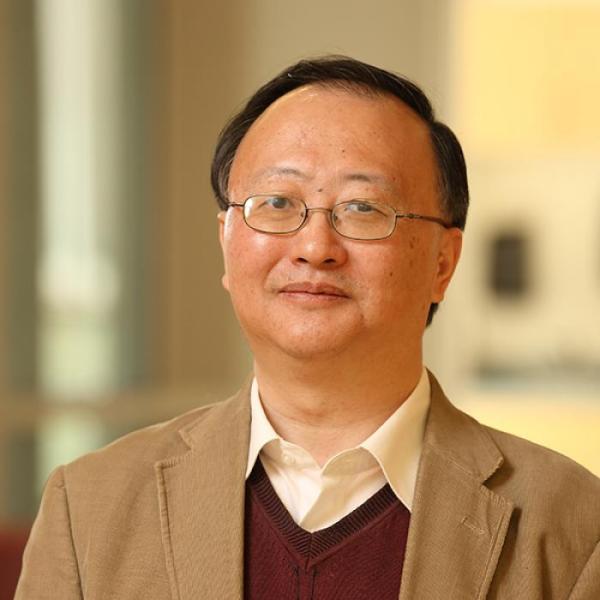
Linda Columbus
Department Chair, Commonwealth Professor of Chemistry and Professor Molecular Physiology and Biological Physics
View Profile

Theoretical and computational work at UVa makes use of advanced analytical and numerical tools to investigate phenomena of interest in fields ranging from biology to materials science to astrochemistry. 

Surface Chemistry focuses on understanding chemical reactions on a molecular level at the interface of two phases of matter, e.g. gas molecules reacting with a solid metallic surface. Spectroscopic analysis is an integral part of this research, enabling researchers to monitor the distributions, concentrations and dynamics of reactants, intermediates, and products in these chemical reactions.

The study of organic chemistry focuses on creating chemical compounds that impact our lives as pharmaceuticals, agricultural products, materials, and polymers, using carbon as the central element. Fundamentally, research in this area develops efficient ways to create structurally diverse and valuable chemical compounds from cheap and abundant precursors. Despite extensive and ongoing research in this area, there are still limitations in terms of cost and practicality associated with the production of many important organic compounds and materials.

The fields of Nanoscience and Materials Chemistry are rapidly expanding and multidisciplinary areas of research with diverse applications in biomedicine, energy conversion and storage, optics, electronics and magnetism, among others. Nanoscience is largely focused on the chemistry of structures, materials, or groups of atoms or molecules on the scale of nanometers (10-9 m or one-billionth of a meter).

The field of Inorganic Chemistry broadly focuses on the study of inorganic compounds, which are generally defined as compounds that are primarily made up of non-carbon elements. In the subfield of organometallic chemistry, chemists study compounds in which there is at least one organic group (i.e., carbon-containing) bonded to a metallic element. This field involves fundamental aspects of both the organic and inorganic chemistry fields.

Molecular detection and quantification are integral to an improved understanding of biological and physiological processes. Research in the areas of Imaging and Sensing is concerned with developing methods and instrumentation to detect and probe specific reactions or molecules in chemically dense environments.

Subscribe to